Safe School Corridors
Repainted crossings, readable signage and trained crossing guards on the routes children walk to school, agreed street by street with headteachers and the municipal authorities.
CSCF is an independent, social-enterprise non-profit delivering full-cycle protection, emergency response and socio-economic recovery across Cameroon. Because the Chia Group network covers our infrastructure, logistics and overhead, every donor contribution goes straight to field programmes aligned with SDGs 3, 4, 6, 8, 10, 11 and 17.
Across Cameroon, thousands of households are made vulnerable not only by sudden crises, but by the absence of immediate response and lasting support afterwards. The Foundation exists to end preventable loss of life, protect human dignity and restore self-reliance when disruption strikes.
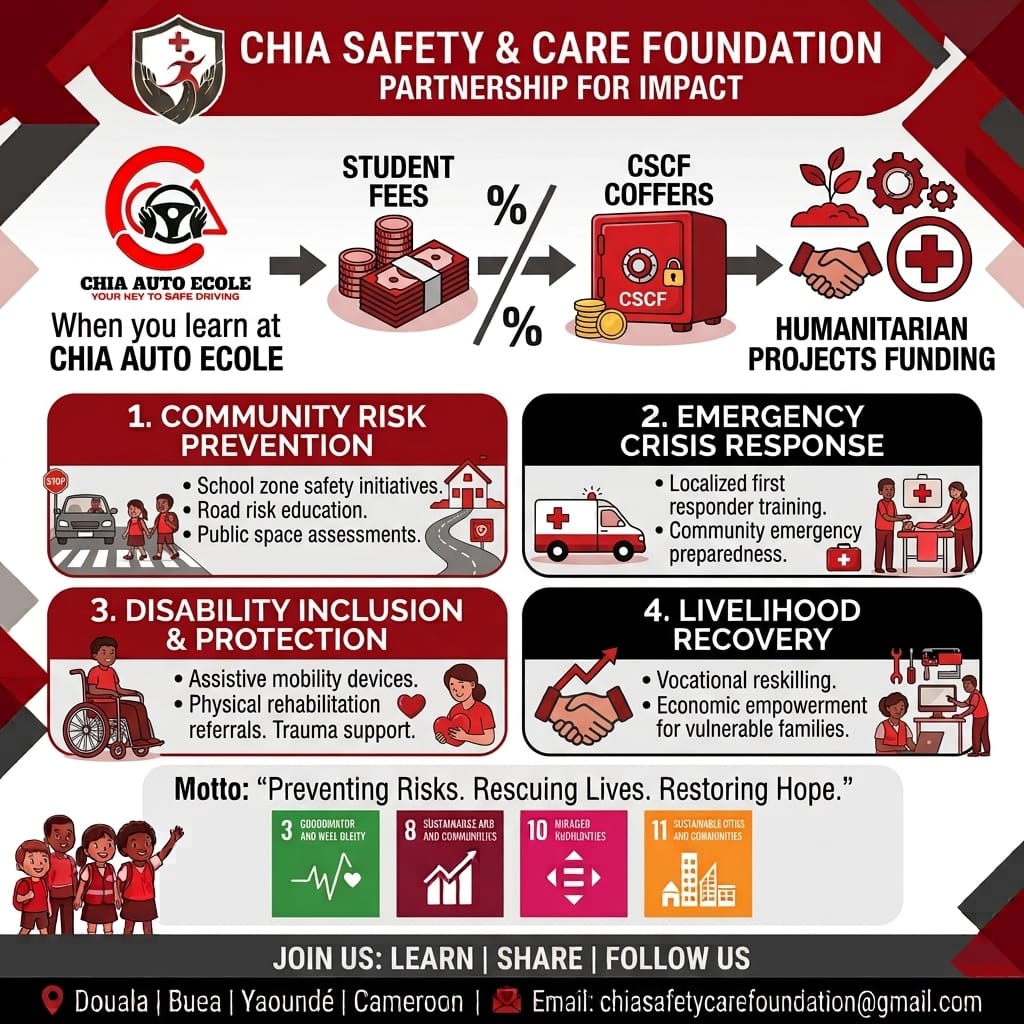
Instead of fragmented, temporary relief, we repair the breakdowns along the whole safety and care chain: protective infrastructure on high-risk school corridors, trained community first responders, full support for people living with any physical disability, re-capitalisation for affected breadwinners and school grants for vulnerable children. Together they turn community failure points into resilient, self-sustaining networks.
How we work
From preventing harm to rebuilding a livelihood, each pillar covers a stage of the same journey, and each is aligned with the UN Sustainable Development Goals.
Before
Safer school zones through traffic calming, pedestrian crossings and crossing guards; road-safety campaigns and driver and youth education; and safety audits of public spaces and transport corridors to find and fix high-risk zones.
SDG 11 · SDG 3
In practice
The first minutes
Training residents, commercial drivers and local leaders in pre-hospital trauma care; rapid alert channels and first-aid kits along high-accident corridors to make the most of the golden hour; and coordinated triage, dispatch and care in the moments after a crash.
SDG 3 · SDG 17
In practice
The months after
For anyone living with a disability, whether from a crash, a congenital condition, illness or other trauma: custom wheelchairs, crutches and prosthetics, rehabilitation and trauma counselling, and barrier-free schools, community spaces and sanitation.
SDG 10 · SDG 3 · SDG 6
In practice
The years ahead
Micro-grants and re-capitalisation for breadwinners whose businesses a crisis derailed, school fees and scholarships that keep vulnerable children and orphans in class, vocational reskilling for survivors, and income support that makes households more resilient.
SDG 8 · SDG 4
Geographic footprint
Targeted local depth for scalable national impact. Rather than spreading resources thin, we work in the urban corridors, regional centres and vulnerable communities where risk and care gaps are greatest, building deep partnerships with health providers, schools, local government and commercial associations so that referrals hold and recovery lasts.
Metropolitan & commercial hub
Focus
School corridor risk prevention, emergency first-responder training, and fast micro-business re-capitalisation for families whose livelihoods a crisis or injury has derailed.
Administrative & transit corridors
Focus
Corridor emergency stabilisation, trauma response, and advocacy for accessible public infrastructure and disability protection across Central Cameroon.
Regional community support centres
Focus
Disability inclusion for people with physical disabilities of any origin, through custom mobility aids, long-term rehabilitation and mental health support, alongside scholarships for vulnerable children and orphans.
Our pilots in these anchor corridors are field-tested models, built to expand to vulnerable households across Cameroon.
Active projects
Concept notes for institutional funders are available for each.
Repainted crossings, readable signage and trained crossing guards on the routes children walk to school, agreed street by street with headteachers and the municipal authorities.
Motorcycle-taxi riders, market traders and shopkeepers trained and equipped to act in the first minutes after a crash, with a clear route to the nearest clinic.
Signage, reflective markers and night-time visibility on the stretches of road with the highest incident rates, and advocacy with transport unions and road authorities for lasting fixes.
Wheelchairs, crutches and rehabilitation referrals for crash survivors and people with disabilities, fitted to the person and followed up afterwards.
News
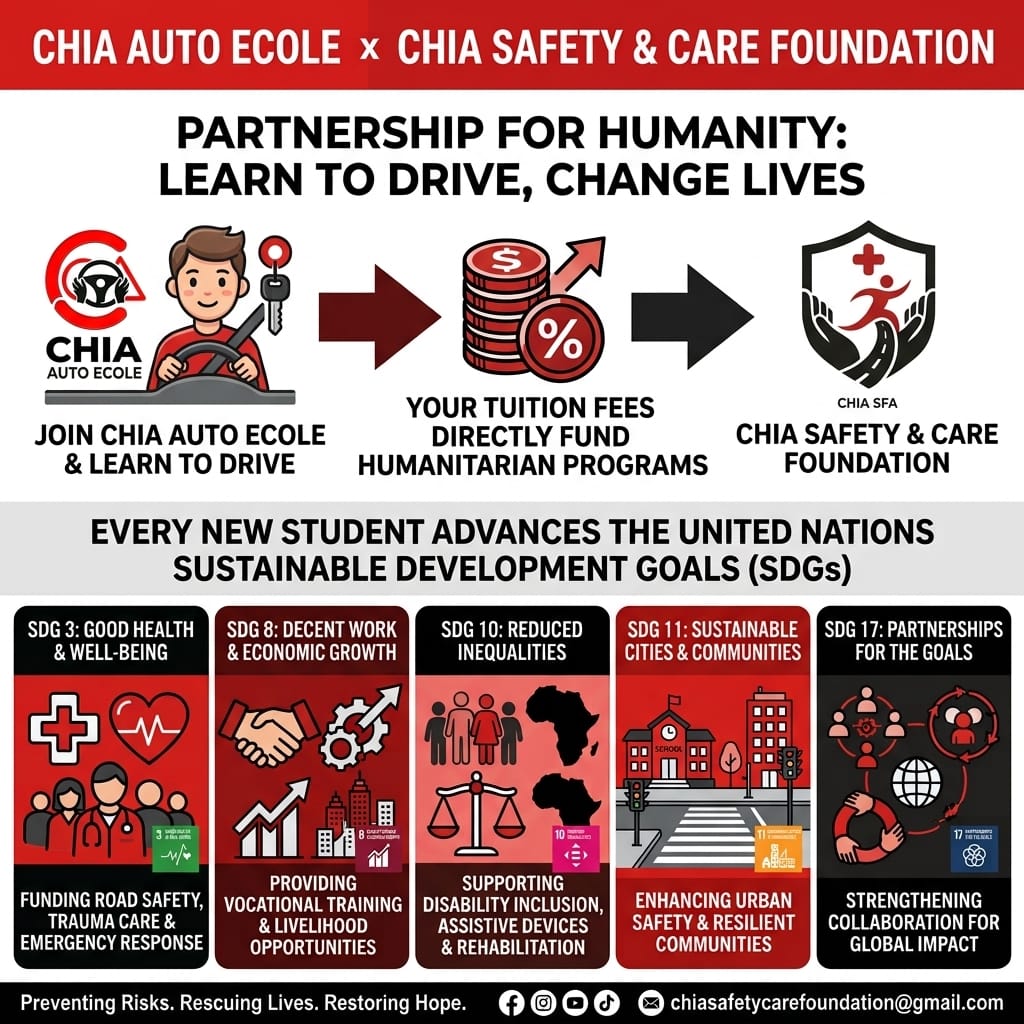
A share of what Chia Auto Ecole earns in tuition comes to the Foundation. Here is what that money pays for, and how the two organisations are kept apart.
Five of the United Nations' global goals describe the work our partnership with Chia Auto Ecole helps to fund. What each one means on the ground in Cameroon.
The people who reach a casualty first are almost never professionals. Five things anyone can do — and two that are better left alone.
Powered by social enterprise
The Chia Group network, including Chia Auto-Ecole and Chia Logistics LTD, sustains the Foundation's infrastructure, logistics fleet and administrative overhead. That leaves every grant and donation free for direct field programmes.
The Foundation keeps a legal, governance and financial identity separate from any commercial entity. It holds bank accounts in its own name, payments above set thresholds need two authorised signatories, and no surplus is ever distributed to members, founders or officers.
Review our transparency page
Institutional funders, local partners and individual supporters all have a role — pick the one that fits.